
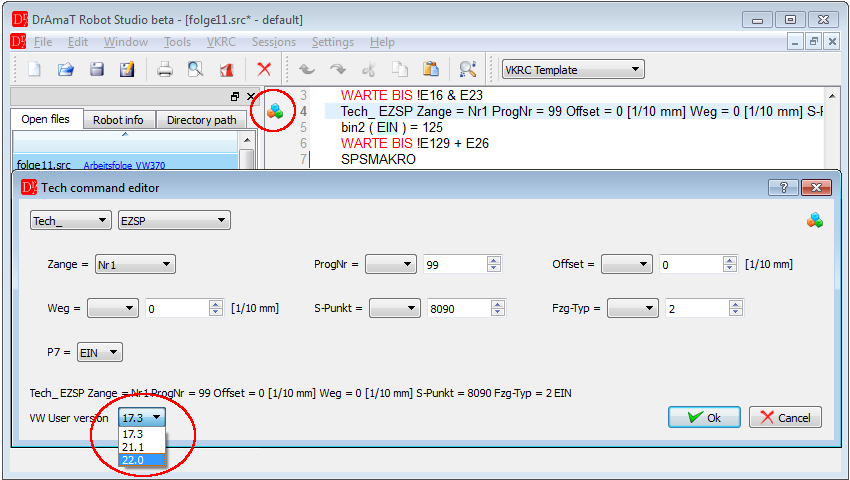
On the left margin you can see a small icon
 ,
which informs the user that the current text line is a VW User technology instruction.
If you want to modify command's parameters just double click on the text line to open options panel with all available VW User commands and their parameters.
When a tech command is inserted or edited, its format follows the TPVW version of the document: 10 values for v.8.1, 13 values with the CN parameter for v.8.3 and higher. The version is taken from &PARAM TPVW_VERSION in the file header or from the robot archive; a standalone file without a version uses the version from the settings. The syntax check uses the same version and reports a tech command whose number of values does not fit as Mismatch of software version and Tech command (see syntax warnings).
In the VKRC toolbar the list of VW users contains only the users of the selected TPVW version (also right after the start), without empty rows. The TPVW lists find the entry also for a version with another patch number (e.g. 8.3.17 → VKRC 4 v.8.3). When the TPVW version in the file header differs from the selected version, the program asks on save; Do not show this message again applies only to the same pair of versions.
In our program we implemented automatic VW User detection after opening a zip archive or cell.src file.
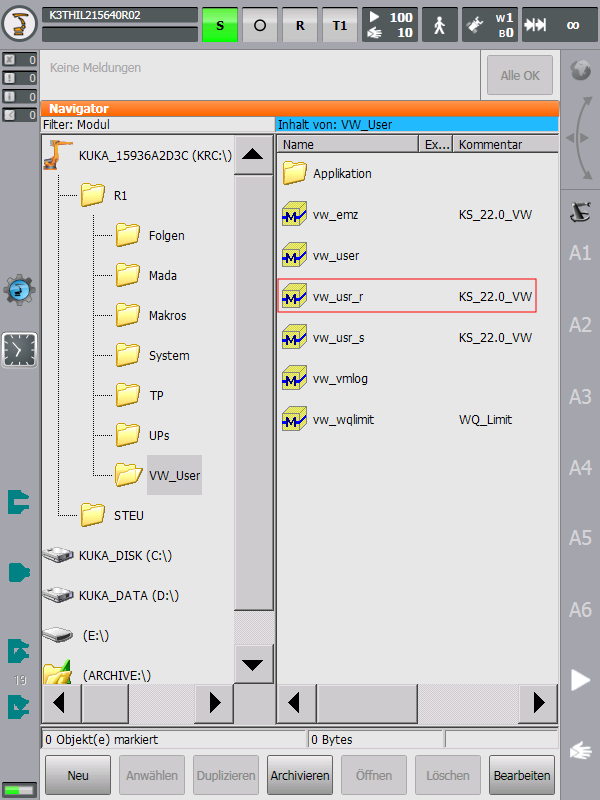
This is done by recognizing a comment assigned to a file KRC/R1/VW_User/vw_usr_r.src.
For example, if the file comment is KS_22.0_VW the VW User version will be 22.0.
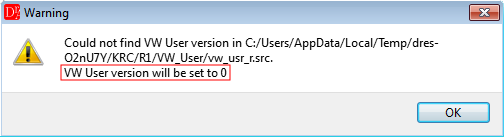
When this comment is missing a popup message is shown to inform about unknown VW User version. In this case to be able to work properly with technology commands you need to configure VW User for version number 0.
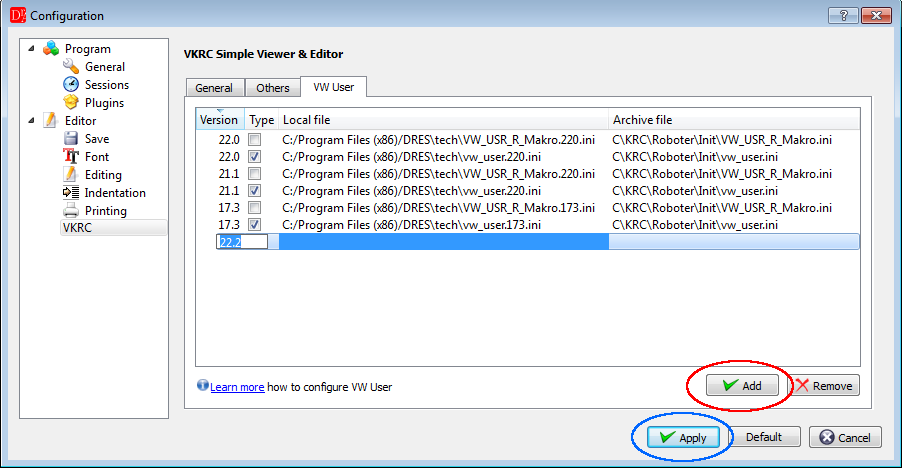
Our program is delivered with some standard VKRC User files, which you can find in the program installation directory. However, if you want to define additional versions you need to define where to find VW User files used to edit technology commands in UP and Folge and KUKA User file used to edit technology commands in Makro.
From version 1.1.4 if you open cell.src or zip archive file the program will try to automatically detect VKRC User
and add it to the editor's resources if it's not included yet.
-
Select Settings → Configure → VKRC → VW User from menu bar and press Add to add a new row
-
Click to edit the first cell and type version number
-
Check whether the second cell is VW User file (for Folge and UP) and leave it unchecked if it is KUKA User file (for Makro)
-
Press Local file cell to open the file window and select the file to be used
(this step is not required for the application's proper working, leave it empty to work always with the actual VW User read from the archive)
-
Click to edit the last cell and type the absolute path to the file in zip archive file
-
Apply changes
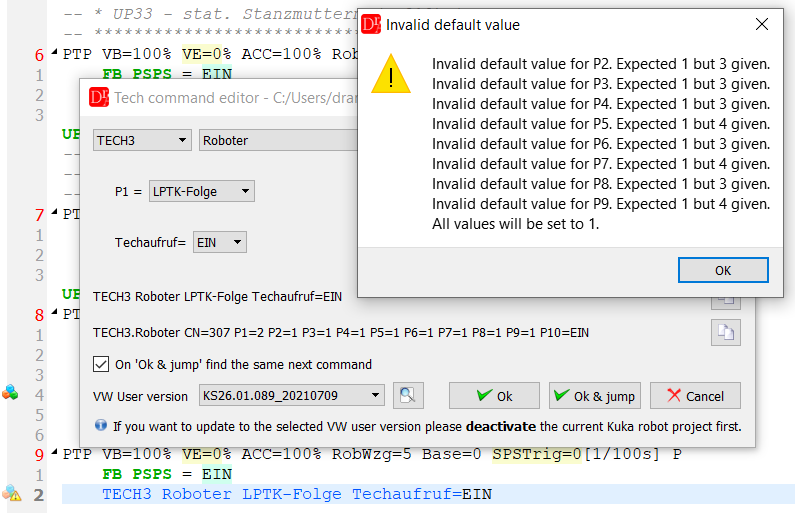
Sometimes the off-line editor or simulation program from third-party companies inserts random numbers for invisible parameters in the VW user technology command.
This error has unpredictable consequences. Our editor helps to fix this mistake. This feature can be disabled in the editor settings.
The editor checks if the value of an invisible (inactive) parameter in a VKRC tech command is equal to the default value.
Technology commands in TXT files
- VKRC → VKRC to TXT writes the line &PARAM TPVW_VERSION into the header of the TXT file. Cancel in the question about the TPVW version of the header stops the export.
- VKRC → TXT to VKRC reads the parameters P1..P10 and the call number CN of a
Tech / Makro command from the part
{VW_USER: ...}of the line. - The TPVW version comes from the header line &PARAM TPVW_VERSION. Without it the version selected in the toolbar is used, or 8.3 / 8.1 taken from the format of the Tech commands when it is clear.
- The program type (Folge, UP, Makro) comes from the DEF line.
Commented technology commands
A technology command commented with VKRC → Comment / uncomment selected text (also inside Folge, UP and Makro) is saved as a VW comment and not executed by the robot: the program contains no call VW_USER / VW_USR_R for it (no entry in the hidden fold {H}, the trigger or the SPS case). The comment contains the visible text of the command and, in curly brackets, its parameters exactly as in a TXT file (VKRC to TXT):;FOLD 4: -- TECH1 EZ/SP/KE Steuerung=Nr1 ... Techaufruf=EIN {VW_USER: TECH1.EZ/SP/KE CN=101 P1=10 P2=99 P3=0 P4=0 P5=3989 P6=3 P7=0 P8=0 P9=0 P10=EIN} -- ;%{SE}%MKUKATPVW %CVW_COM %VCOMMENT ...
TPVW 8.3 and higher: CN and P1..P10; TPVW 8.1: P1..P8 (P8 = case number), e.g.
{VW_USER: TECH2_.Koll_Ueb P1=2 P2=1 P3=1 P4=5 P5=1 P6=1 P7=EIN P8=204}. In a Makro the brackets
contain {VW_USR_R: ...}. Group and subgroup names with spaces and dots are kept.
When the file (or a TXT file) is opened again, such a comment is recognized as a commented technology command with all its parameters; Comment / uncomment selected text makes it an active command again with the same group, subgroup, CN and P values. Also a comment line written by hand as
-- text {VW_USER: group.subgroup CN=.. P1=..} --
becomes a technology command when it is uncommented. A comment without the part {VW_USER: ...} stays a normal comment.
The syntax check does not report a commented technology command.
The comment is longer than a usual VW comment (128 characters), because the parameters must stay complete.
Commenting a technology command can not be undone with Undo - comment it again to restore it.
A commented point (point fold) is saved as a commented fold (;;FOLD ... ;;ENDFOLD, see
Comment / uncomment selected text); the technology commands in it
are saved as described above and come back with their parameters.