
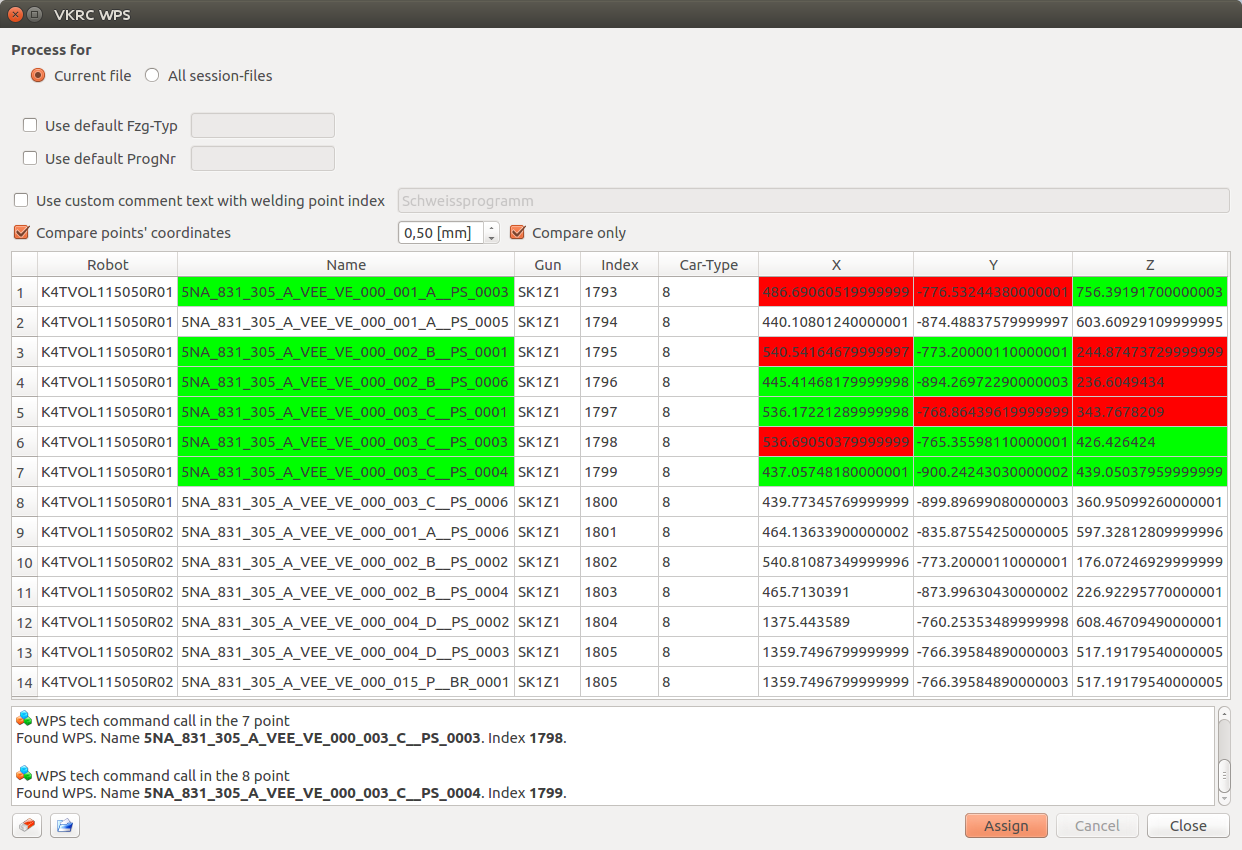
Plugin main window
The VKRC WPS extension is used to assign welding points' parameters from A33 sheet or customized one from the comment above the point, to the VW User tech command Tech_.EZSP and (since 2026-11-10) to the weld folds SERVOZANGE of KUKA VW (KRC4) programs, see Supported weld commands.
The plugin can compare X, Y and Z points' coordinates with the coordinates in the A33 sheet with the given distance tolerance.
Above every welding point the plugin expects one of the following comment formats:
- customized keyword and welding index after it, eg.: -- Schweissprogramm 1793 --
- valid point name from A33 sheet, eg.: -- 5NA_831_305_A_VEE_VE_000_001_A__PS_0003 --
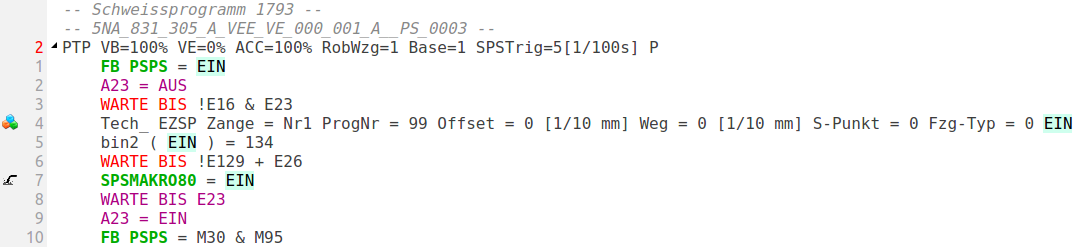
Welding command example
If you do not check Use custom comment text with welding point index option the plugin will check for each point with the welding command Tech_ EZSP call (or a SERVOZANGE weld fold)
all comments above that point and try to find a corresponding entry in the loaded welding points' list.
If any point name from the table matches the text in the comment the plugin will set the given index and the car-type parameters to the VW User command.
If no A33 sheet is available you can assign welding indexes directly from the available comments.
Check Use custom comment text with welding point index. The plugin will check all comments above the welding point. In case any point starts with the given text
the plugin will remove chosen text and try to convert the remaining text to a number and assign it to the VW User command.
In the installation directory you can find an examples directory with A33 sheet and up3.src. Open this file in the editor, run VKRC WPS plugin and load A33 sheet.
Press the Process button to assign all parameters to the points. You can load a few A33 sheets into the table.
Supported weld commands
Only programs of the types Folge and UP are processed.| Robot / standard | Weld command | Weld point number / car type / program |
| KUKA VKRC (VW) | tech command Tech_.EZSP (the VW User command of the welding point reader settings) | parameters of the command: index P5, car type P6, weld program P2 (numbers of the parameters from the welding point reader settings, defaults: gun P1, weld program P2, index P5, car type P6) |
| KUKA VW (KRC4) | weld fold SERVOZANGE n Schweissen ... Programmnummer= ... Punktnummer= ... FahrzeugTyp= ... | Punktnummer / FahrzeugTyp / Programmnummer of the fold |
SERVOZANGE (KUKA VW KRC4)
For a fold SERVOZANGE n Schweissen the plugin searches the point of the plan as follows:- Search by index: by the weld point number of the fold (Punktnummer); when the fold has a car type (FahrzeugTyp other than 0), only plan points of this car type (or without a car type) are taken. A number that is more than once in the plan gives the message The weld point number n is m times in the plan, the first point is used.
- Search by name: by the name in the comment above the point (-- name --, M_COMMENT), the comments directly above the point are checked from the bottom up. When several plan points have this name (e.g. several car types), a selection dialog Multiple welding point opens, as for Tech_.EZSP.
- Use custom comment text with welding point index (with Search by name): the number after the text of the comment (e.g. -- Schweissprogramm 1793 --) is searched in the loaded plan - for SERVOZANGE the plan must be read before the option is switched on (with the option on, the table and the Read A33 button are locked).
- Punktnummer = the index of the plan point,
- FahrzeugTyp = the car type of the plan point, or the value of Use default Fzg-Typ when this option is on,
- Programmnummer only with Use default ProgNr (otherwise the weld program is not changed).
Compare only does not change the program: the cells Index and Car-Type of the plan point in the table are coloured green when they are equal to Punktnummer / FahrzeugTyp of the fold, else red. Compare points' coordinates works as for Tech_.EZSP (X, Y, Z of the point with the plan, within the tolerance).
The console shows for every fold SERVOZANGE in the n point, Index: ... (search by index), Found WPS. Name ... Index ... or Could not find any matching WPS index, and then Changed: <new header line> or Parameters already set (nothing to change).
Note - search by name: the plugin takes the number of the plan point that has the name of the comment. When
the comments of a program carry the names of another car type or of another station (e.g. comments copied with
the program), the wrong numbers are written. Check the programs with the
Weld plan check first (number, name and robot of every weld point compared with
the plan) and use Compare only before Process.
Options of the window
| Option | Default | Meaning |
| Process for: Current file / All session files | Current file | the active editor or all open files (Folge first, then UP) |
| Use default Fzg-Typ + value | off, empty | writes this car type instead of the car type of the plan (Tech_.EZSP P6, SERVOZANGE FahrzeugTyp); an empty value leaves the car type as it is |
| Use default ProgNr + value | off, empty | writes this weld program number (Tech_.EZSP P2, SERVOZANGE Programmnummer); off = the program number is not changed |
| Use custom comment text with welding point index + text | off, empty (hint Schweissprogramm) | the number is taken from the comment that starts with this text (works with Search by name); switches off the coordinate compare, Compare only, the tolerance and the table |
| Compare points' coordinates | off | compares X, Y, Z of the point with the plan point |
| Tolerance [mm] | 0 (the last value is remembered) | distance tolerance for the coordinate compare |
| Compare only | off | only colours Index / Car-Type of the table, the program is not changed |
| Search by: name / index | name | plan point by the name in the comment above the point or by the weld point number of the command |
| Buttons | - | Configure welding point reader (columns, rows, sheets of the A33 sheet and the structure of the tech command), Clear WPS points' list, Read A33, Howto, Process, Cancel, Close |
Excel files: A33 sheets in the Excel workbook format (
.xlsx, .xlsm) are read by an
own reader of DrAmaT Robot Studio with the columns, rows and sheets of the welding point reader settings (button
Configure welding point reader) -
MS Excel is not needed. MS Excel is only used for files in the old format .xls. Coordinates
written with a decimal comma are read as numbers too.
To compare the spot welds of whole robot archives with the plan (weld point number, name, robot, position, shifted base) use the window Weld plan check (menu VKRC / KRC » Weld plan check..., same license).
A33 sheets may have different formats. The structure of the table is fully configurable and can be adapted to different files.
Go to Menu → Settings → Configure → Welding point reader tab.
You can specify the range of rows with welding points' parameters, numbers of sheets, and columns' names with the parameters.
To be 100% flexible and independent from changes in the VW User you can define the welding tech command structure too.
In the figure below you can see example settings for the welding point reader according to the VW User tech command.
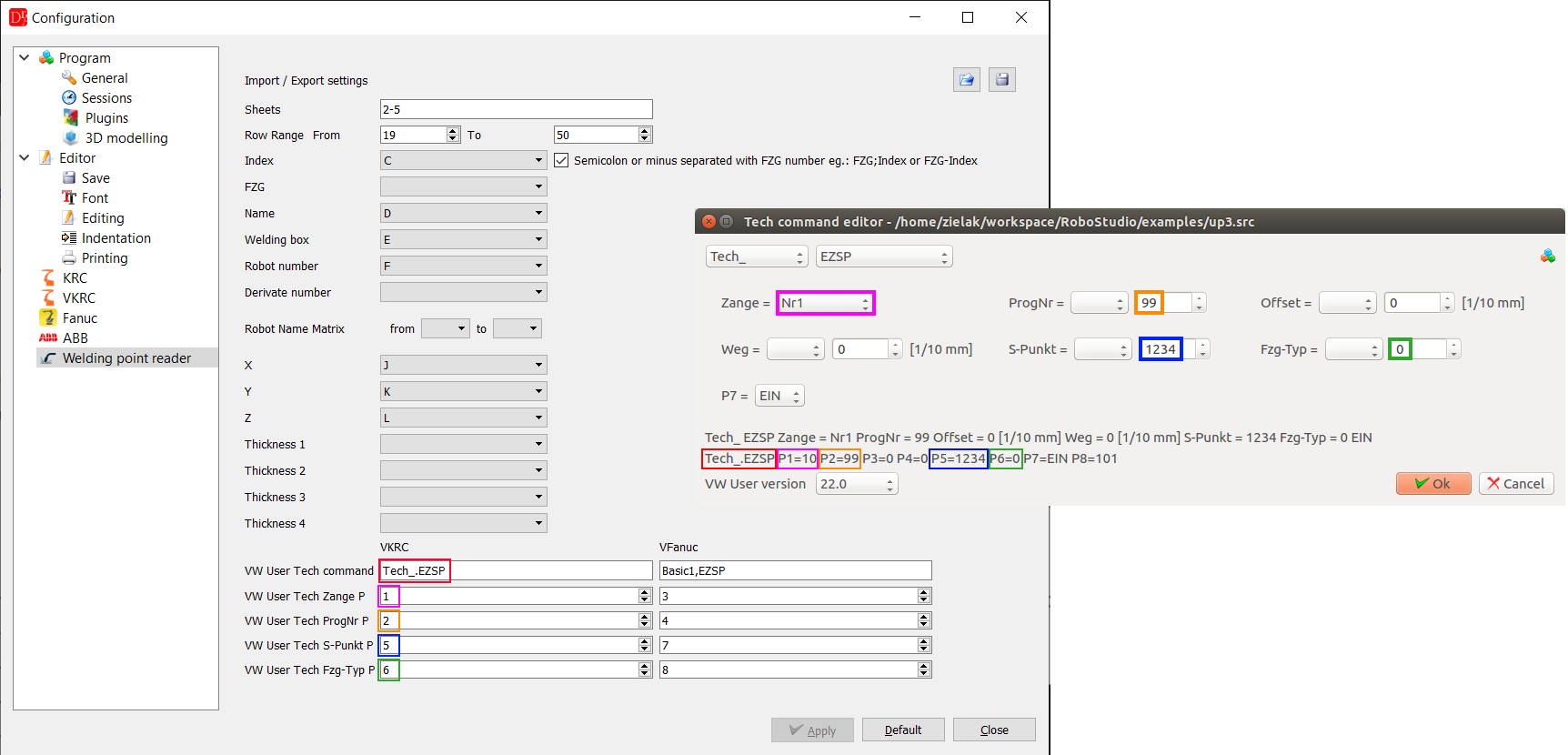
Welding point reader global settings