
- What the export is for
- Starting the export
- Export options
- Structure of the archive
- Loading the archive on the robot
▲ What the export is for
The export creates a ZIP file with the folder structure of a KUKA archive (KSS 8.x): KRC/R1/Program/..., KRC/R1/System/..., C/KRC/..., am.ini. Every program keeps the path it has in the archive of the robot, so all changed programs can be loaded on the robot in one operation (restore of an archive) instead of copying them one by one.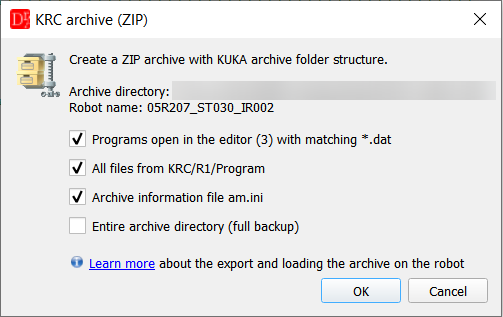
Export options of the KRC archive.
▲ Starting the export
KRC » More » Export to KRC archive. The option is active when a KRC program (*.src) is the current window.The same export is started with the
 button in the Robot toolbar
(next to Compare files). It exports for the robot type of the current program; if no robot program is open,
for the active robot project in the project tree. Without an open program and without an active robot project the
editor asks to set a robot project as active (context menu Set active robot) or to open a program.
button in the Robot toolbar
(next to Compare files). It exports for the robot type of the current program; if no robot program is open,
for the active robot project in the project tree. Without an open program and without an active robot project the
editor asks to set a robot project as active (context menu Set active robot) or to open a program.
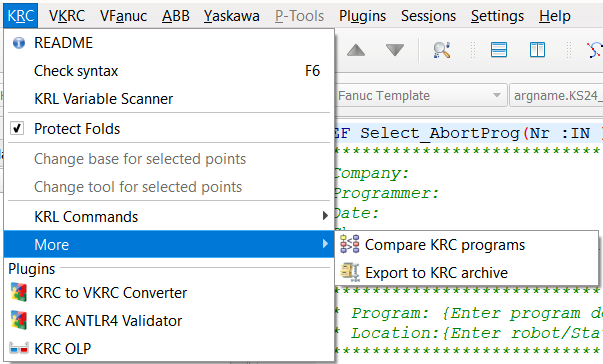
The export in the menu KRC » More » Export to KRC archive.
Before the export save all programs that are open in the editor - the export works on the files
on the disk. If a program has unsaved changes, the editor activates it and stops the export.
For every open KRC program the editor looks for the archive folder of the robot: going up from the folder
of the program, the first folder that contains am.ini or the subfolder
KRC/R1. The path of the program inside the archive is taken from there, e.g.
...\Robot_R01\KRC\R1\Program\Test\cell_a.src →
KRC/R1/Program/Test/cell_a.src.
- If programs of more than one robot are open, the editor asks which archive should be exported - one ZIP always contains the programs of one robot. Programs of the other robots are skipped.
- If no program is open, the archive folder of the active KRC project is used (only the folder options are available).
- The name of the ZIP proposed in the save dialog is the robot name from am.ini ([Roboter] RobName).
▲ Export options
| Option | What is put into the archive |
| Programs open in the editor with matching *.dat | every open *.src together with its *.dat (found in the same folder, regardless of upper/lower case), under its path in the archive |
| All files from KRC/R1/Program | the whole KRC/R1/Program folder of the robot with subfolders |
| Archive information file am.ini | a copy of the original am.ini of the archive (robot name, KSS version, tech packages). Note: it describes the complete archive the files come from. Off by default |
| Entire archive directory (full backup) | the complete archive folder of the robot; all other options are disabled |
- Machine data - files from Mada folders or KRC/STEU are added only after a confirmation (default No).
- Programs outside a KUKA archive (e.g. a single .src in a work folder) - the editor asks whether they should be put into KRC/R1/Program/ in the archive.
Machine data. Machine data belong to one particular robot (calibration, serial number). Loading them onto
another robot damages its configuration. Entire archive directory contains them - restore such an archive only
on the same robot.
After the export
The editor shows a summary with the number of files in the archive. Show Details... lists every file of the archive with its path, the files that were skipped and why (another robot, machine data, file not found) and the notes of the export.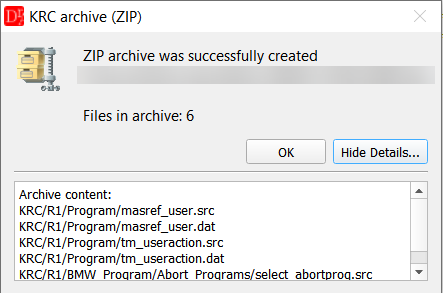
Summary after the export - Show Details... lists the content of the archive.
The archive is written to a temporary file first and replaces the target file only when it is complete - if something goes wrong (disk full, file open in another program), no half-written ZIP is left on the disk. Two different files that would end up under the same name in the archive stop the export with a list of the conflicting files. The same file selected twice (e.g. open in the editor and part of a selected folder) is simply added once.
The selected options are remembered for the next export.
▲ Structure of the archive
Example - two open programs, option Programs open in the editor:Robot_R01.zip └ KRC/R1/Program/Test/cell_a.src └ KRC/R1/Program/Test/cell_a.dat └ KRC/R1/Program/Gripper/gripper_open.src └ KRC/R1/Program/Gripper/gripper_open.dat
▲ Loading the archive on the robot
- Copy the ZIP file to a USB stick (or to the network archive path configured on the robot).
- On the smartPAD log on as Expert (or higher), select operating mode T1 and deselect / cancel the selected program.
- Main menu » File » Restore and choose what should be restored:
- Applications - the user programs (KRL modules) and their folders; the right choice for an archive with programs only,
- Configuration - configuration files (e.g. from KRC/R1/System, C/KRC/...),
- All - everything contained in the archive.
- Wait until the restore is finished; the configuration may require a cold start of the controller.
- Check the loaded programs before starting the robot.
Make an archive of the robot (File » Archive » All) before loading the new files, so that you can go
back to the previous state. Alternatively, the files can be unpacked on the PC and copied with the Navigator of the smartPAD.
See also the export for the other controllers: VKRC, VFanuc, ABB, Yaskawa